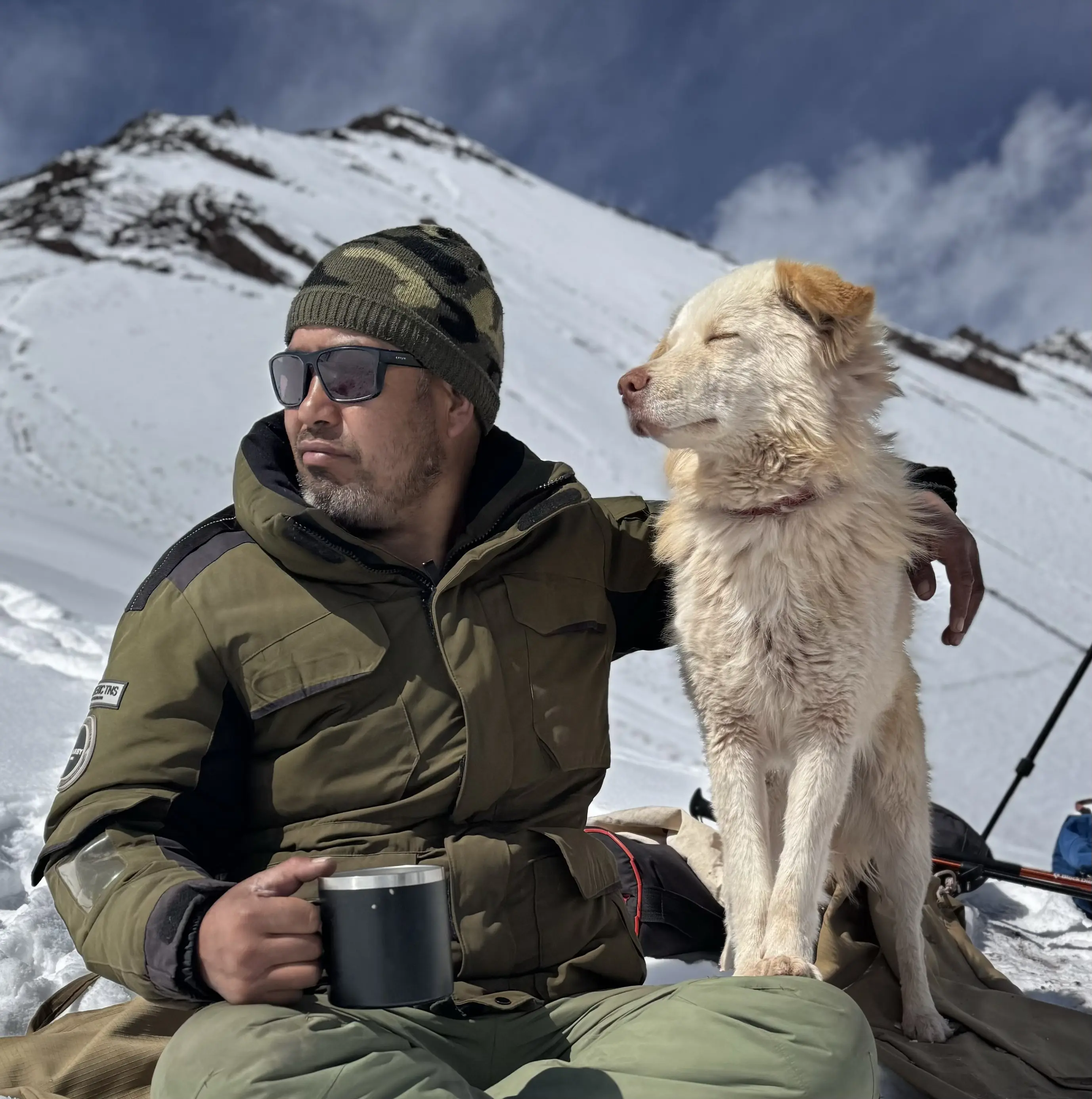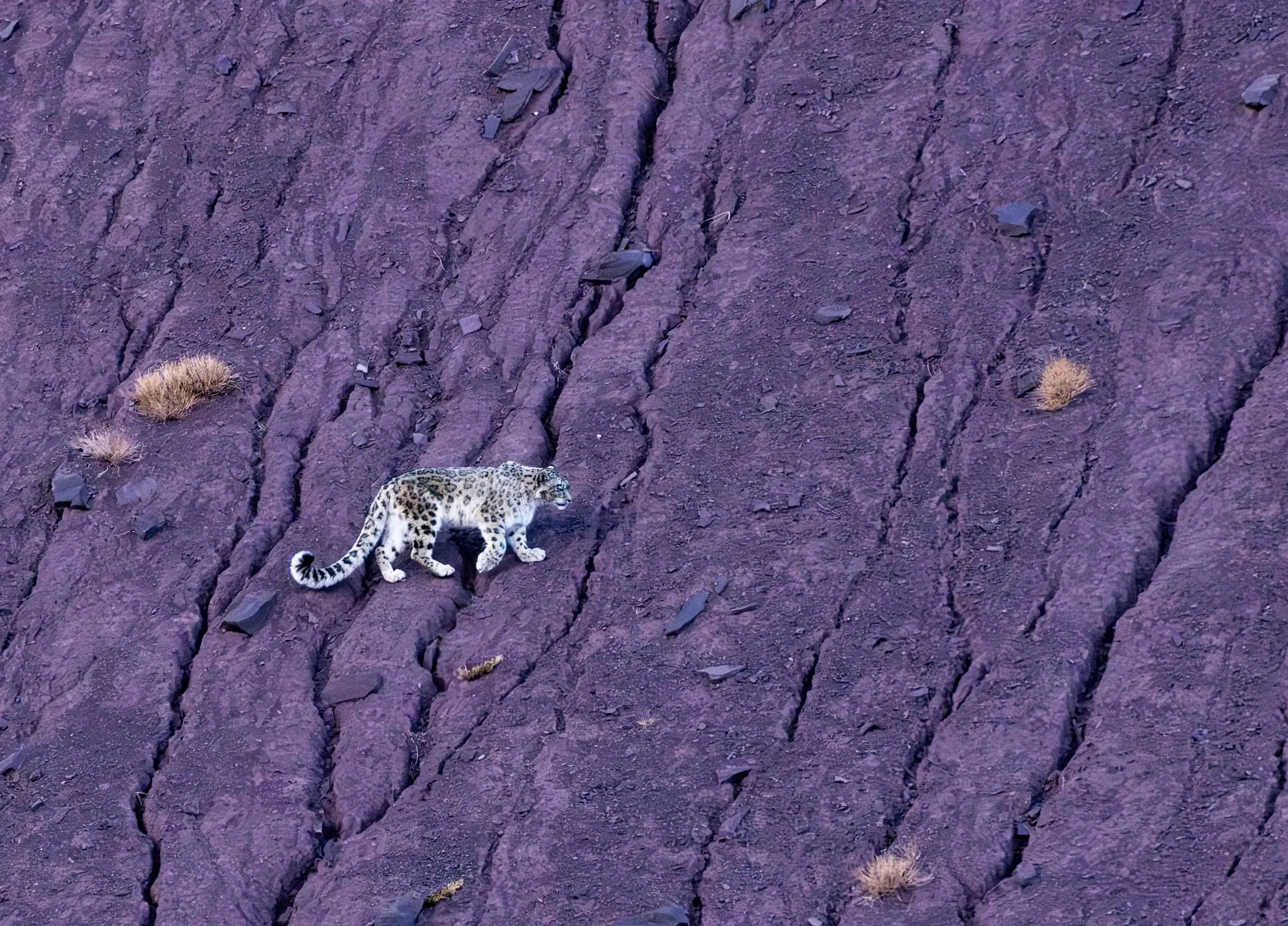


I have spent more than 15 winters in the frozen river valleys of Hemis National Park and other snow leopard territory in Ladakh. I have sat motionless on ridge-lines at minus 20°C, watching a snow leopard behaviours, how difficult for mother leopard to raise cubs, drag a blue sheep three times its weight up a near-vertical cliff face. I have also spent entire weeks seeing nothing but tracks in the snow and the ghost of a tail disappearing around a boulder.
Both of those experiences are part of snow leopard tracking in Ladakh — and if you are planning to come here, you deserve to know exactly what both feel like.
This is not a tourist brochure. This is what actually happens.
Before We Start: Why "Safari" Is the Wrong Word
When people book a snow leopard tour in Ladakh, they sometimes imagine something like an African safaris — vehicle, guide, big cat visible from 50 metres and sometime next to your safari jeeps.
Snow leopard tracking is nothing like that.
The snow leopard (Panthera uncia) is one of the most elusive predators on earth. Hemis National Park spans 4,400 square kilometres of some of the most broken, vertical, and inaccessible terrain in Asia. The leopard moves across that terrain mostly at dawn and dusk, often in wind and snowfall, across cliffs that no vehicle and no human can easily follow.
What we do is not chase. We read the landscape until the landscape gives up its secret.
That distinction — between chasing and reading — is the core skill of everything I am about to describe.
The Night Before: Work You Never See
Most guests arrive at base camp in Hemis National Park like in Rumbak village or Ulley or Lungnak valley of Zanskar and go to sleep excited. What they don't know is that my team has already been working for several hours.
Every evening before a tracking day, my spotters split across several vintage high positions above the valley. They are not looking for leopards at night — they are checking prey. Bharal (Himalayan blue sheep) Ibex, Ladakh urial herds move in patterns. They graze high in the afternoon, move to mid-slope by evening, and if they are nervous — bunched tight, facing upslope, not grazing — it means something has been watching them. Moments of bird of prey. That nervousness is information.
Elite Expedition India spotters also check kills. A snow leopard can take a bharal weighing 40 to 60 kilograms and may feed on the same carcass for three to five days, returning to it each night. If we confirmed a kill in the previous 48 hours and it has not been fully consumed, there is a reasonable chance the leopard will return before first light. Basically if there is a kill made by lone leopard, then the chances are leopard will stay with the kill for at least three days.
By the time guests wake up at 5.30 AM, I already have a rough probability map in my head: which drainages are worth watching first, which ridge lines to scope, which areas have gone cold.
This preparation — invisible to guests, completely unglamorous — is actually the most important work of the day.
5.30 AM: The spotting Scope Session and What We Are Really Doing
We position our spotting scopes before full light, usually by 5:30 AM. The reason is simple: snow leopards are most active at dawn, hunting or moving between resting sites before the sun rises and temperatures drop further.
But here is what most tracking guides do not tell you: we are not simply scanning for a leopard shape. We are reading the entire eco system.
Reading prey first: I look at every angulate herd visible from our position. I count individuals. I check their posture. A herd that has been chased within the last hour will be spread out on high open ground, not grazing, all facing the same direction — away from wherever the threat came from. That tells me where the leopard was, even if I cannot see it.
Reading terrain for ambush points: Snow leopards do not chase prey across open ground — they ambush. They use specific features: the narrow gully where bharal descend to water, the concave cliff wall where their grey-gold coat becomes near-invisible against pale rock, the boulder field where a single lunge from above covers six metres instantly. I know every such point in the valleys we work. I point scope those locations systematically, not randomly.
Reading the snow: Fresh snow from the previous night is one of our most powerful tools. Pugmarks in fresh snow tell us not just that a leopard passed, but when (based on how much wind has softened the edges), in which direction, at what pace (walking marks look different from bounding marks), and whether it was carrying prey (the drag line between tracks is unmistakeable). I can look at a snow leopard track and tell you whether this animal is a resident I know or a transient passing through.
Reading scent marks: Snow leopards are solitary and territorial. They communicate primarily through scrape marks (shallow dirt scratches near trail junctions), spray marks (urine on overhanging rocks), and cheek rubs on boulders. Finding a fresh scrape — dark turned earth, not yet frozen — tells me a resident leopard was here within 12 to 24 hours.
All of this together builds a picture. By 7 AM, even on a day when we have not yet seen a leopard, I know approximately where in the valley system the animal is likely to be resting.
How Angulate Movement Tells Us Where the Leopard Is
This is the part of snow leopard tracking that even experienced wildlife photographers do not fully understand until they have spent time with a tracker who grew up in these valleys.
The angulates and the snow leopard have co-evolved for thousands of years. The blue sheep is not simply prey — it is a sensor network. Every herd in the valley is constantly assessing predator risk, and their behaviour broadcasts that assessment in real time if you know how to read it.
Here is what I watch:
Alarm calls: Angulates produce a sharp, nasal bark when they detect a predator. The direction they face when calling tells me where the threat is. The pitch and repetition tells me whether the predator is actively hunting or simply resting nearby.
Herd compression: When a snow leopard is within 200 to 300 metres and moving, a bharal herd will compress tightly — individuals clustering together — and begin moving upslope in a tight group. This is flight preparation. When I see this through the scope, I immediately shift my optics to the terrain below and behind the herd.
Return patterns: After a leopard has moved through or rested long enough that the bharal no longer feel threatened, they will slowly begin spreading and grazing again. Watching which direction the herd eventually relaxes toward tells me which way the leopard went.
I learned this system not from a textbook but from 15 winters watching it. The bharal,Ibex essentially, are doing part of my tracking for me — if I am patient enough and quiet enough to let them.
The Moment a Leopard Is Found: What Actually Happens
I want to be honest about this because most blogs describe it as a smooth, cinematic experience. It is not.
When one of my spotters calls in a visual on a leopard — over radio or by running down the ridge (radios sometimes fail in deep valleys) — the next 20 to 40 minutes are controlled chaos.
The call comes in: My spotter gives a landmark reference — "above the third cliff band, left of the big rockfall, in the shadow." I find the location on my scope, confirm the sighting, assess whether the leopard is moving or resting.
We assess approach: This is critical. A snow leopard that detects human presence will move immediately and may not return to that area for days. We do not run toward the animal. We assess: wind direction (we must be downwind), available cover along the approach route, whether the terrain allows a position within good photography range without cutting across the animal's likely exit path.
I brief the guests quickly: "We are going to move fast to the ridge junction, then slow and low across the slope. No talking. Phone ringers off. If I put my hand down, everyone stops and crouches." Most guests are already shaking at this point. That is fine — I am too, still, after 15 years.
The approach: We move in single file where cars can not reach. Terrain inside the Hemis National Park or outside the park. — it is loose scree, frozen stream crossings, sometime snow in shadow zones.
Positioning: I choose where guests stand based on three factors: background (a pale rock background makes for better photography than a dark shadow), sight line (no obstructing boulders), and safety margin from the leopard's likely exit direction. I want guests close enough for satisfying photography but positioned so that if the leopard moves, it moves away from us, not through us.
If everything works, and it often does not, guests will have 20 minutes to two hours or sometime full day watching a snow leopard in its natural habitat — resting, scanning, occasionally marking, or actively hunting.
If it does not work — if the leopard scents us, or a second, unseen bharal herd alarms and alerts the leopard before we arrive — we return to scope positions and start reading again.
A Day With No Sighting — And Why That Is Part of the Experience
I am going to tell you about a day that I remember specifically because nothing went the way I wanted.
It was February 2019. A family from the Netherlands booked a package from our website — father, mother, teenage daughter — had come for 7 days. Day one produced no sighting. Day two produced no sighting. Day three, we found tracks on the frozen river, a scrape, and bharal that were clearly nervous. We positioned ourselves above the main drainage and waited four hours. The leopard never appeared.
On day four I found the explanation: a second snow leopard, a transient male, had entered the valley. Our resident female — the one I had been tracking through bharal behaviour — had retreated to the upper gorge to avoid conflict. In three days she had covered nearly 12 kilometres of near-vertical terrain and was now above the snow-line, in country we could not safely access with guests.
I told the family exactly this. I showed them the tracks — two sets now, of different sizes, the female's retreating, the male's advancing. I explained the territorial mechanics. The daughter, who had been quiet the first three days, asked me how I knew the tracks were from two different animals rather than one animal crossing twice. We spent 45 minutes sitting on a frozen riverbank talking about pugmark measurement, stride length, and claw impression depth.
On day five, in the last hour of light, we found the transient male on a cliff face above camp.
But here is the point: the four days without a sighting were not failed days. They were education. The guests from the Netherlands wrote to me six months later — the daughter had enrolled in a wildlife biology programme at university and cited that conversation on the frozen river as a defining moment.
I tell every group the same thing at the start: if you come to Ladakh to see a snow leopard, you are gambling with odds. If you come to understand how a snow leopard lives, you cannot fail.
The Role of Village Networks: Intelligence That No Technology Replaces
Hemis National Park covers territory spread across multiple high-altitude valleys: Rumbak, Husing, Sumdah, Gunmatse, Skiu, and many more. No single team can watch all of it.
My early warning system is the village network.
Every shepherd community in these valleys has lived alongside snow leopards for generations. In the past, leopards were feared and sometimes killed because of livestock predation. In the last 15 years, with conservation incentives and tourism income, that relationship has fundamentally changed. Shepherds are now our most valuable partners.
When a shepherd in Rumtse valley sees pugmarks crossing the frozen stream at first light, he calls me. When the women of Rumbak village, who carry fodder to their animals before dawn, notice that their livestock were agitated in the night — they tell me. When a herder in the upper Markha valley finds a fresh bharal kill with the characteristic bite marks at the throat, he knows within a few hours whether the carcass is still being fed on, and he calls.
This informal intelligence network, operating through basic mobile phones (signal is intermittent but present in most valley floors), gives me a real-time picture of snow leopard activity across an area far larger than my team can directly observe.
BBC Planet Earth and National Geographic used our village network when they filmed here. The crew could not have found their subjects without it. That is not modesty — it is the reality of working in this landscape.
Photography Positioning: The Decisions Behind the Shot
I know what a good snow leopard photograph looks like. I have watched hundreds of photographers stand exactly where I put them, use their equipment exactly as I briefed them, and come away with images they have used as profile photographs for years.
Here is how I think about positioning.
Distance: Snow leopards habituated to human presence in well-monitored areas like Hemis and Ulley can tolerate observers at 70 to 90 metres if approach has been low and downwind. Less habituated animals may require 100 to 200 metres. I prefer toward the safer distance — a sharp image from 150 metres with a 500mm lens is far better than a blurred image from 40 metres because the animal was disturbed and moved.
Background: Pale ochre rock or snow provides contrast for the leopard's coat. Dark shadow behind the animal loses all detail. I look for a position that puts the animal against a lighter background even if it means a slightly longer approach.
Light angle: Early morning, the light comes from the east. I try to position guests so the sun is broadly behind them, illuminating the leopard's face. A leopard photographed into the light is a silhouette. I have seen this mistake made by professional photographers who did not listen to my positioning briefing.
The exit corridor: I always identify where the leopard is most likely to move if disturbed, and I ensure no guest is positioned in that direction. A snow leopard running toward a group of photographers is not a better photograph — it is a dangerous situation and a guarantee the animal will not return to that area.
For video: Steady platform, not handheld. Tripod or monopod for telephoto video is non-negotiable. I carry carbon-fibre tripods and monopods for guests who have not brought their own.
What Guests Get Wrong — And How to Fix It Before You Arrive
After 15 years and hundreds of groups, I have seen the same mistakes repeatedly.
Wearing bright colours: Red jackets, orange beanies, white gaiters — these are visible to bharal at extreme distances and will alarm prey animals, which then alarms the leopard. Dress in earth tones, grey, or olive drab. Completely.
Underestimating the cold: The valley floor temperature at 5 AM in January can reach minus 22°C or less with the wind. I have had guests whose fingers became too numb to operate their camera shutter within 20 minutes of arriving at scope position. Bring more insulation than you think you need. Hand warmers. Merino base layers. Down gloves that you can remove quickly to shoot.
Impatience with the scope sessions: Two hours of looking through a spotting scope across a snowy valley is genuinely hard work. Eyes tire, concentration drifts. The leopard you are looking for is roughly the colour of the rock it is lying on. I have had guests who wandered away from their scope to make tea and missed the sighting. Stay at your position. Stay ready.
Not being honest about their fitness level: Leopard tracking requires walking across steep, loose terrain at altitudes between 3,800 and 4,800 metres. If you have a knee problem, a heart condition, or have never acclimatised to high altitude, tell me before you come. I will design a programme that keeps you safe and still productive. What I cannot do is manage a medical emergency at 4,500 metres with no advance preparation.
Talking during approach: The sound of human voices carries extraordinary distances in these still, cold valleys. I brief every group on this. Every group nods. Several times a year, someone forgets.
Sighting Statistics: What the Numbers Actually Mean
I am sometimes asked by guests what our sighting success rate is. I want to answer this honestly rather than with marketing numbers.
Having a local spotters with decades of experience finding leopard and residing in the same habitat makes a huge difference. All our spotters are equipped with world best Swarovski scopes and binoculars which make easier to scan the mountain and finding leopard. Check out essential equipments required for snow leopard expedition which you can also rent from us depends on the availability.
Over five-day expeditions in peak season (January through March), our groups achieve at least two to three confirmed visual sighting of a snow leopard some time many. We have a record of seeing 11 leopard in 5 days too.
What that figure does not tell you: the quality of the sighting varies enormously. Some sightings are two minutes of a leopard crossing a ridge-line 400 metres away — enough to confirm the animal, not enough for satisfying photography. Some sightings are three hours watching a leopard rest on a boulder below 100 metres from our position, groom, scan, and eventually descend to feed on a cached kill.
I cannot control which kind of sighting you get. I can control the quality of the tracking, the expertise of the positioning, the depth of the experience around the sighting.
What I can promise: if you are with me and a snow leopard is findable in that valley on that day, we will find it.
What This Landscape Gives You Even Without the Leopard
I want to end with something that took me years to understand, and that I now try to communicate to every group.
Ladakh snow leopard landscape in winter is one of the last places on earth where a genuinely intact predator-prey ecosystem operates largely undisturbed by human industrial activity. The angulates, the snow leopard, the Tibetan wolf, The golden eagle, the Himalayan griffon vulture, the red fox, the bearded vulture — these animals are not in a managed reserve with supplemental feeding and veterinary care. They are living and dying by the same rules they have lived and died by for thousands of years.
When you sit for four hours on a frozen ridge-line and nothing happens, you are not wasting time. You are learning to read a landscape on its own terms. You are understanding, in a way that no nature documentary can convey, what it means for an apex predator to survive winter at 4,000 to 5000 metres on an animal it must catch and kill across near-vertical terrain.
The snow leopard is called the Ghost of the Mountains. I have chased that ghost for 15 years. Some days it lets me find it. Most days it teaches me patience.
Both are worth the cold.
I Abdul Rashid the founder and guide, tracker of Elite Expedition India. Has guided wildlife photographers and conservation researchers from National Geographic, BBC, and multiple international universities. Has been tracking snow leopards in India - Ladakh and other snow leopard countries like Mongolia and Central Asia since 2009.
For expedition dates, availability, and pricing for our Ladakh snow leopard tours, contact us directly. We run small groups only — maximum six guests — to minimise disturbance and maximise the quality of each experience.