
Know the Snow Leopard — Ghost of the Mountains
Everything you need to know about Panthera uncia — camouflage, habitat, diet, threats, mating, and what it takes to witness one in Ladakh's frozen valleys.
Snow leopards (Panthera uncia), known as the "ghosts of the mountains," are elusive, solitary big cats adapted to the high-altitude, cold, and rocky environments of Central and South Asia. They are classified as vulnerable, with an estimated 3,920–6,390 left in the wild, inhabiting 12 countries including India, China, Mongolia, and Nepal. They are distinguished by their thick smoky-grey fur, extraordinarily long tails, and the notable inability to roar.
 Physical Characteristics & Adaptations
How camouflaged is the snow leopard, and why is it called the "Ghost of the Mountains"?
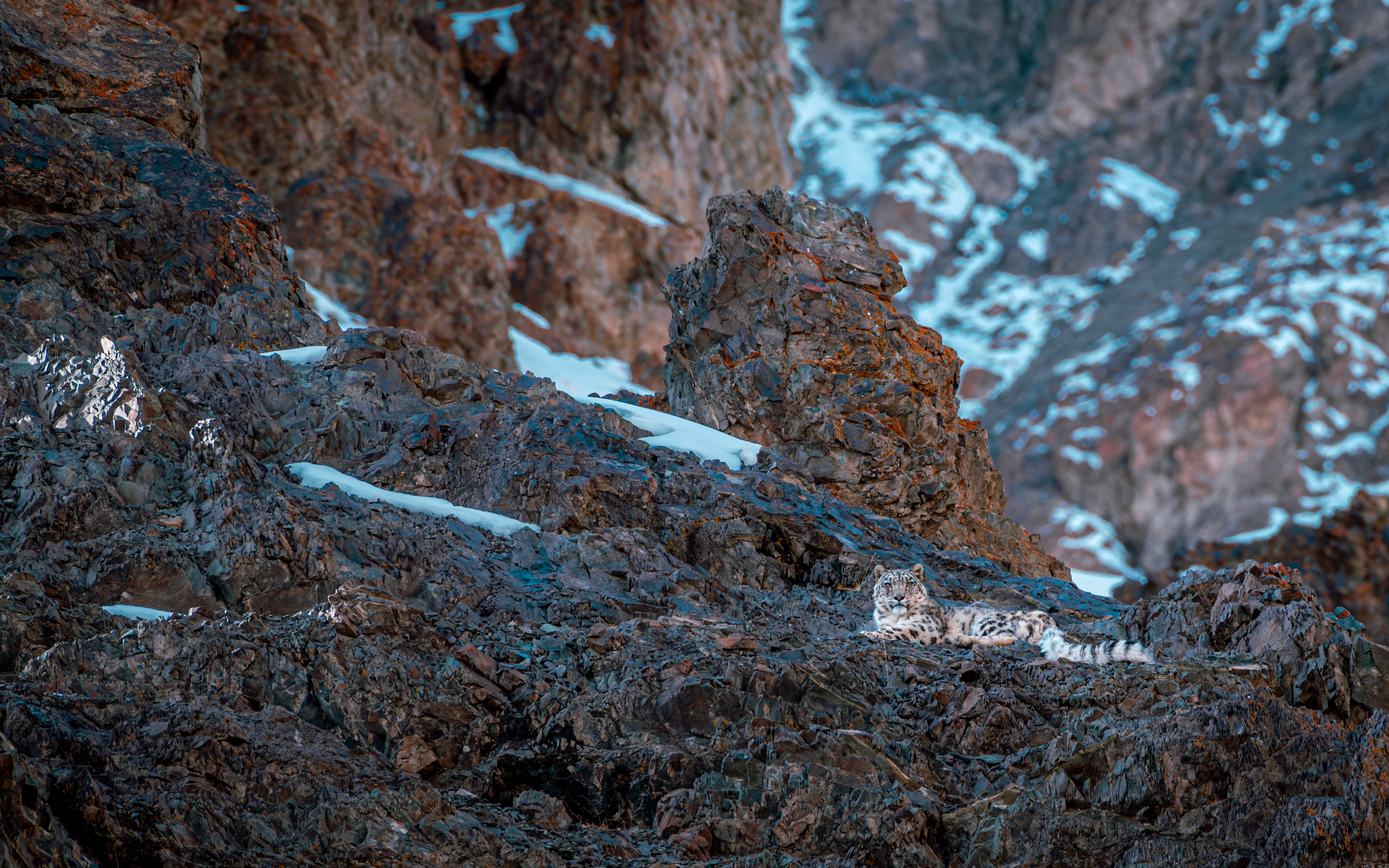
The snow leopard is a master of hiding. Its thick, smoky-grey and white fur looks exactly like the rocky mountains where it lives. Dark spots and rings cover its coat, breaking up the shape of the cat's body so it can disappear into rocks, shadows, and snow. Its fur even changes with the seasons — turning whiter in winter to match the snow, and darker grey-yellow in summer to blend with rocks and dried plants.
This perfect disguise allows the snow leopard to stalk prey for hours without ever being detected. Even experienced trackers who know the terrain intimately can stare directly at a resting leopard and not see it. That is precisely why the name "Ghost of the Mountains" has stuck for centuries.
How do snow leopard paws act like snowshoes and grip steep cliffs without slipping?
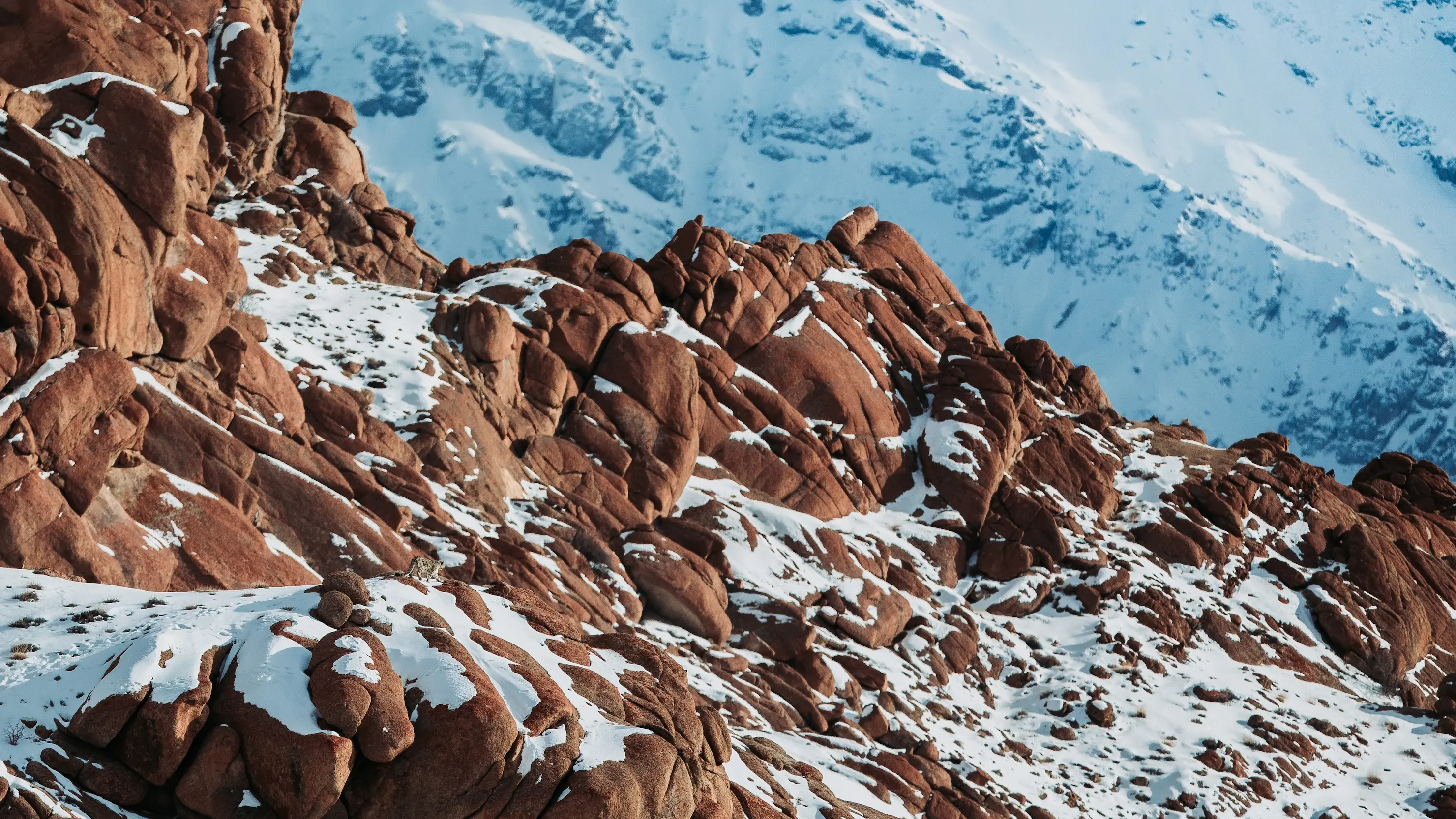
A snow leopard's oversized paws are one of its most important survival tools. Because they are so wide, they spread the cat's body weight across deep snow, preventing it from sinking — exactly like a pair of snowshoes on a human.
The soles are covered in thick fur that acts as both thermal insulation and grip. This fur keeps the feet warm against frozen ground and prevents slipping on ice, while the strong retractable claws bite into rock walls on vertical ascents. Flexible wrists let the paws grasp uneven boulders from any angle after high leaps across mountain cliffs. They are medium-sized cats, weighing 35–50 kg, with short forelimbs and powerful hind legs that allow leaps of up to 15 metres.
How do snow leopards breathe in thin air, and why don't they get altitude sickness?
Snow leopards have a breathing system precisely engineered for high-altitude life. They have unusually large chest cavities and highly developed lungs, allowing them to draw in massive volumes of oxygen-thin mountain air with every breath.
Their short, wide nose contains large nasal passages filled with warm blood vessels that act as a natural heater — warming the icy air before it reaches the lungs, preventing cold-induced lung damage during high-speed chases. Unlike humans, who rely on changes in blood proteins to adjust to altitude, snow leopards combine their large respiratory system with a slow, energy-conserving lifestyle. Their brains and muscles therefore never suffer from oxygen deprivation, even above 6,000 metres. They possess greenish or grey-coloured eyes, which are also adapted for the bright UV-reflective snow environment.
Why can snow leopards not roar?
Snow leopards cannot roar because of the special shape and structure of their throats. Unlike lions and tigers, snow leopards do not have the thick, flexible pad of cartilaginous tissue on their hyoid bone — the anatomical feature that allows deep, resonant roaring. Their throat bones are firm and rigid rather than elastic.
Because their throat parts cannot stretch or vibrate deeply, they are limited to high-pitched howls, growls, hisses, and a soft puffing sound called a "chuff". Remarkably, these sounds actually travel better through the thin, windy mountain air than a low-frequency roar would. Nature gave them the communication tool that works best in their environment.
How dense is snow leopard fur, and how do they cope with –40 °C temperatures?
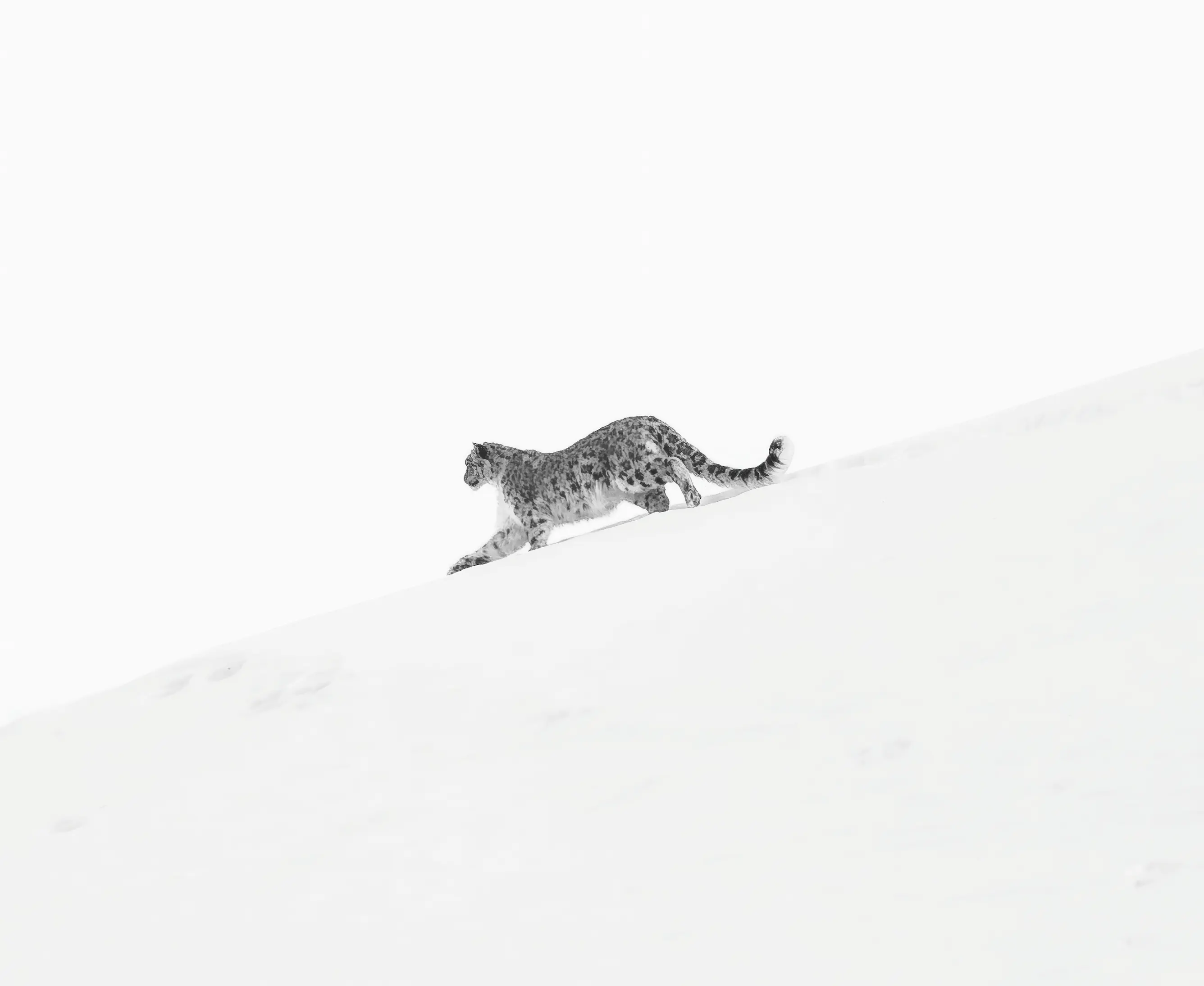
Snow leopards have the densest fur of any big cat species, packing nearly 4,000 hairs per square centimetre — approximately 26,000 hairs per square inch. This incredible woolly undercoat is roughly 20 times denser than human head hair and serves as a powerful thermal barrier against temperatures that can drop as low as –40 °C.
The individual hairs on their back grow up to 5 cm long, while the fur on their belly can reach 12 cm in length — protecting vital organs when resting directly on ice and frozen rock. This plush, dense armour covers their entire body including their ears and wide paws, functioning as built-in insulation and snowshoes simultaneously. They also wrap their long, bushy tail — which reaches 80–105 cm — around their face like a scarf while sleeping to trap body heat.
 Habitat, Behaviour & Diet
"Snow leopards are found across 12 countries, yet fewer than 6,400 survive in the wild. Ladakh's Hemis National Park is one of the most reliably productive places on Earth to witness them — and our trackers were born in this territory."
Where do snow leopards live, and which 12 countries can you find them in?
Snow leopards live in the cold, rugged mountains of Central and South Asia, across 12 different countries: India, China, Mongolia, Nepal, Bhutan, Pakistan, Afghanistan, Russia, Kazakhstan, Kyrgyzstan, Tajikistan, and Uzbekistan. India's Ladakh region — specifically Hemis National Park — is widely considered the world's best accessible location to observe them in winter.
They prefer steep, rocky landscapes with cliff faces, ridges, and deep ravines where they can easily hide and hunt. Because their habitat is so vast and fragmented, they are spread thinly across enormous mountain ranges, choosing the most remote areas to avoid human contact.
How high do snow leopards live, and do they migrate with the seasons?
Snow leopards are high-altitude specialists, typically thriving at elevations ranging from 3,000 to 4,500 metres above sea level, though they can ascend to 6,000 metres in the Himalayas during summer. They occupy steep, rocky terrain, alpine meadows, and ravine habitats, usually living above the tree line.
In winter, they migrate to lower elevations — sometimes as low as 1,200–2,000 metres — following their prey which also moves downslope to find food. This winter migration is exactly why the November-to-April season is the best time for sightings in Ladakh. Deep snow at higher altitudes forces both the leopard and its prey down to valleys that are accessible to trackers.
What kind of terrain do snow leopards prefer, and why do they avoid open landscapes?
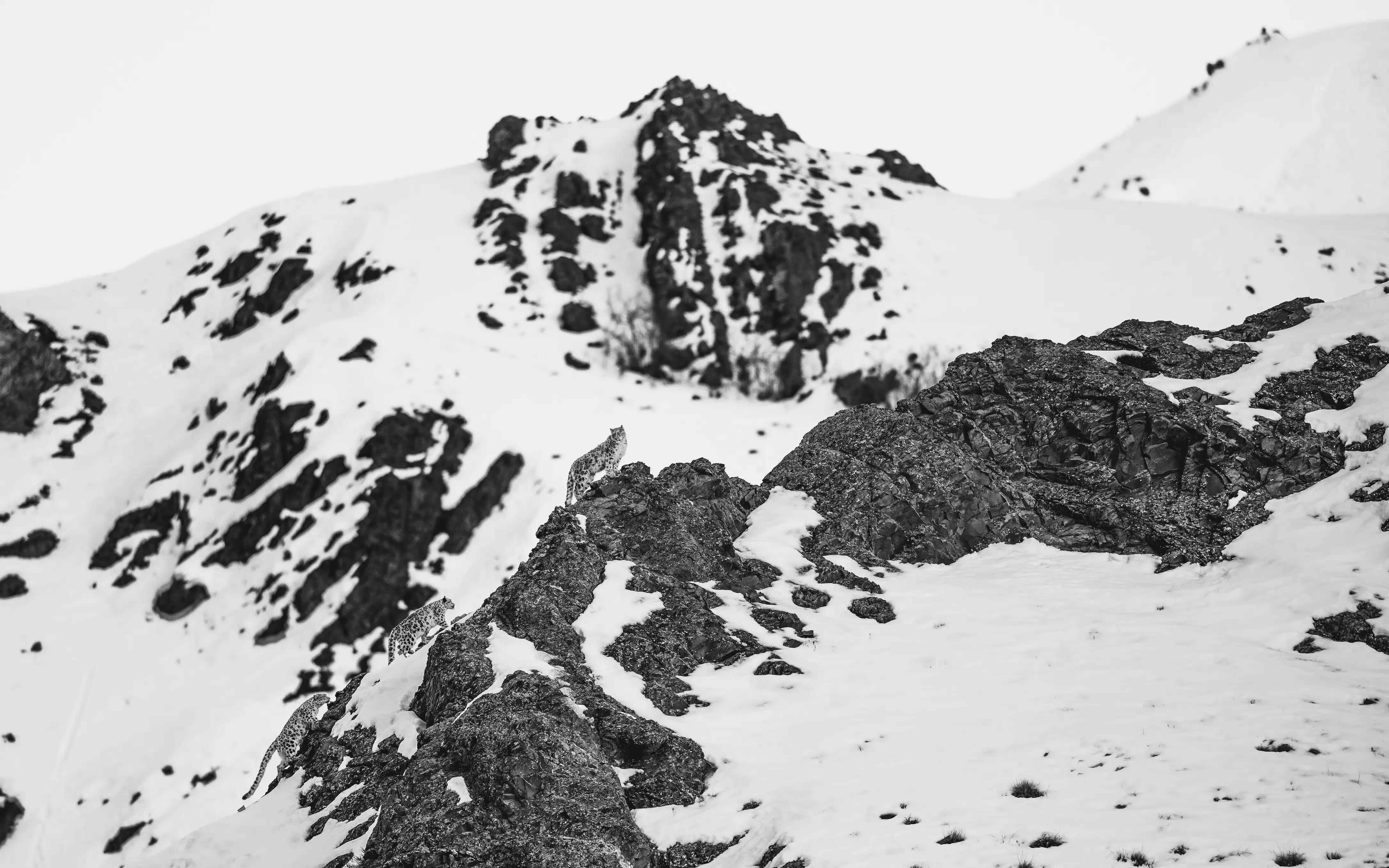
Snow leopards strictly prefer steep, rugged, and broken terrain such as cliffs, rocky outcrops, ravines, and talus slopes. These fractured landforms provide optimal camouflage, shelter from harsh winds, and strategic high ground from which to monitor their territory and ambush prey.
They naturally avoid wide open landscapes and dense forests — their camouflage and hunting style are entirely built around jagged, broken rock. This rough topography also aids their unique hunting style, allowing them to use gravity to accelerate downhill and overpower agile mountain prey that would outmanoeuvre them on flat ground. They often move to lower elevations in winter following prey, and return to higher peaks in summer.
Why do snow leopards live alone, and when are they most active?
Snow leopards are highly solitary predators that live almost entirely alone — the only exception is mothers raising their cubs. They are primarily crepuscular, meaning they are most active during the twilight hours of dawn and dusk, when their prey is also most active and when low light gives them a hunting advantage through their camouflage.
To minimise direct confrontation in their vast mountain territories, they communicate extensively through scent markings, urine spraying, and claw scrapes on prominent rocks — a silent messaging system that can tell other leopards who passed through, when, and in what condition. Because they are exceptionally elusive and blend seamlessly into rocks, researchers rely heavily on remote camera traps to study their secretive social structures and low-light behaviours.
What do snow leopards eat, and how do they hunt?
Snow leopards are strict meat-eaters that primarily hunt blue sheep (bharal) and Siberian ibex — the two most common large prey animals in their range. When large prey is scarce, they supplement their diet with argali wild sheep, marmots, pika, and birds.
They are remarkably powerful hunters, capable of killing animals up to three times their own body weight. Their preferred technique is a gravity-assisted downhill ambush — using steep terrain to accelerate and overpower agile prey. Because each hunt requires enormous energy expenditure, a single large kill can sustain a snow leopard for up to a week or more.
How large is a snow leopard's territory, and how do they avoid fighting each other?
Because prey density is extremely low in the cold, harsh mountains, a single snow leopard requires a massive home range — sometimes spanning up to 1,000 km². Male snow leopards hold larger territories than females, and these areas often overlap with multiple females' ranges.
Rather than fighting over territory, they use an elaborate system of scent marks and scrapes on prominent rocks and cliff ledges to broadcast their presence. A fresh scent mark communicates identity, reproductive status, and time of passing to any other leopard that passes through. This sophisticated communication system means two leopards sharing overlapping territory may live their entire lives without ever meeting face to face.
When do snow leopards mate, and how do mothers protect their cubs?
Snow leopards mate only in February and March because, as solitary, high-altitude animals, they use late winter to seek out mates across their vast territories. This timing ensures cubs are born in June or July — in late spring when the weather is warmer and prey is more available for the mother to feed herself while nursing alone.
After a gestation period of 90–100 days, the female gives birth to 2–3 cubs (sometimes up to 5) in a secret den hidden deep within steep cliffs and rocky crevices. The mother lines the den floor with a thick blanket of her own plush belly fur, which she pulls out herself to insulate the cold rock. The cubs' spotted grey fur keeps them camouflaged while the mother is away hunting. Cubs remain with their mother for up to two years, meaning females breed only every other year.
What is the lifespan of a snow leopard in the wild versus in captivity?
In the wild, snow leopards typically live for 10 to 14 years. Life in the freezing mountains is demanding — extreme weather, high-stakes hunts on sheer cliffs, injuries from prey, and food scarcity in old age all take a serious toll.
In captivity, with regular meals, safe shelter, and expert veterinary care, individuals have been documented living past 22 years. The controlled environment eliminates the constant physical risks and food insecurity that shorten wild lives significantly.
Threats, Safety & Conservation
What are the main threats to snow leopards, and are they in danger of extinction?
The main threats come directly from humans. Roads, mines, and overgrazing by livestock are fragmenting mountain ecosystems and scaring away the wild sheep and goats that snow leopards depend on. When natural prey disappears, starving leopards turn to farm animals — which leads angry herders to kill them in retaliation. This retaliatory killing is one of the leading direct causes of mortality.
Illegal poaching for fur and bones continues despite international protection — a single pelt can fetch thousands on the black market. And rising temperatures from climate change are melting snow and pushing the tree line upward, potentially destroying up to one-third of snow leopard habitat within decades. Snow leopards are currently classified as Vulnerable by the IUCN — not yet Endangered, but urgently at risk.
Why are snow leopards endangered, and what can actually be done?
Snow leopards are in danger because humans are attacking their survival from multiple directions simultaneously — habitat destruction, prey depletion, direct killing, poaching, and climate change are all happening at once, and the species reproduces slowly enough that it cannot recover from heavy mortality.
Effective conservation requires protecting the entire ecosystem, not just the animal. This means ranger training, predator-proof livestock corrals that stop the cycle of retaliatory killing, stray dog sterilisation programs (dogs compete with leopards for prey and carry disease), and community education that gives local people an economic stake in the leopard's survival. At Elite Expedition India, 20% of our annual profits go directly to these conservation programs in Ladakh.
At Elite Expedition India, 20% of our annual profits fund ranger training, predator-proof livestock corrals for local herders, stray dog sterilisation programs, and community education — reducing human–wildlife conflict while creating sustainable livelihoods in snow leopard territory.
Do snow leopards ever attack humans?
Snow leopards are not dangerous to humans and have never been known to actively hunt or view people as prey. There has never been a single verified case of a snow leopard attacking a human being in the wild — making them one of the gentlest of all the big cats around people.
These shy cats are exceptionally submissive around humans. When cornered near a livestock kill, they almost universally flee or hide rather than confront. Even when researchers approach wild snow leopards trapped in camera-trap devices to fit GPS collars, the cats typically remain completely quiet and still rather than fighting back. You are in far greater danger from the altitude than from the animal.
What are the natural predators of the snow leopard?
Adult snow leopards sit at the very top of the mountain food chain — no wild animal actively hunts them for food. Humans are their only real predators, through illegal poaching, retaliatory killing, and habitat destruction.
Defenceless cubs can occasionally fall prey to wolves, lynx, or large eagles if their mothers are away hunting. As climate change warms the mountains, wolves and common leopards are being pushed upslope into snow leopard territory, creating increasing territorial competition over food and space — though this is rivalry rather than predation.
How do snow leopard mothers hide their babies in secret dens to keep them safe?
Snow leopard mothers are remarkably careful den-builders. The mother selects a cave or rock fissure that is completely hidden from wind and impossible for other predators to see or reach easily — usually deep within a cliff face. She lines the cold rock floor with a thick blanket of her own plush belly fur, which she pulls out herself before the birth to create a warm nest.
She leaves her cubs in this hidden shelter only when absolutely forced to go and hunt for food. She relies on the den's secret location and the cubs' spotted grey fur — which breaks up their outline against rock and shadow — to keep them invisible during her absence. The cubs are entirely dependent on this camouflage for their first months of life.
Why do snow leopards mate in February and March, and once a year only?
Snow leopards mate only in February and March because they are solitary, high-altitude animals that use the late winter months to find mates across vast, spread-out territories — timing their mating so that cubs are born in late spring (June/July), when warmer weather and more available prey give newborns the best chance of survival.
This once-a-year cycle is essential: the mother needs warm weather and sufficient prey to raise the cubs entirely alone after a 100-day gestation. Furthermore, because cubs stay with their mother for up to two years, she physically cannot mate again until they have left her territory. This slow reproductive rate is one of the key reasons the species is so vulnerable to population decline — each lost adult is extremely difficult to replace.
Written by the People Who ❤️ Track Snow Leopards for a Living
For more than 15 years, Elite Expedition India has been operating in the heart of snow leopard habitat in Ladakh. Every detail in this guide is based on real field experience, thousands of hours of observation, and deep respect for the Ghost of the Mountains.
Responsible • Ethical • Passionate • High Success Rate
Ready to witness one in the wild?
Join our small-group Snow Leopard expedition in Hemis National Park — high sighting rates, full conservation accountability.
Travel with purpose into some of the world’s last wild places, where nature remains raw and untamed. Every expedition is thoughtfully designed to respect wildlife, support local communities, and contribute to conservation—ensuring your journey leaves a positive footprint long after the adventure ends.